
B2B Marketing Post-11/22: The Four Things You Must Know and Do

Key Takeaways
The traditional B2B marketing funnel is dead. Since November 2022, generative engines like ChatGPT, Perplexity, and Gemini have automated vendor research and evaluation — buyers arrive at your website only after AI has already filtered the options.
40% of enterprise buyers use AI to vet vendors before visiting a company website. Another 30% are building autonomous agent workflows that will make purchasing decisions without human input.
If buyers don't recognize your brand before a crisis hits, you've already lost the deal. Pre-intent brand equity — built through targeted short-form video and geotargeted audio — is now a pipeline protection strategy.
GEO determines whether AI engines cite your brand or ignore it. Structured schema, server-side rendering, and explicit AI crawler permissions are no longer optional technical details — they are the infrastructure of modern B2B visibility.
AI ranks authority by original research, third-party validation, and community mentions — not keyword volume. Brands that publish proprietary data and earn citations on G2, Reddit, and industry publications dominate AI search. Generic content disappears.
A dedicated GEO strategy reduces Time to Convert (TTC) by 30–50% within 12 months.
Artificial intelligence is not a new discipline. The foundational concept was officially established in 1956 at a Dartmouth University summer research project, where visionaries first treated machine intelligence as an academic field of study.
For more than six decades, however, AI remained confined to theoretical computer science labs, niche data applications, and subtle backend algorithms. It had zero tangible impact on day-to-day corporate marketing.
Then came November 2022 – the public launch of ChatGPT fundamentally disrupted the global commercial landscape.
This was a revolutionary shift that fundamentally redefined how humans access information, solve problems, and purchase enterprise-grade solutions. A recent report found that 51% of B2B software buyers now begin their purchasing process in an AI chatbot rather than a traditional search engine — and they increasingly return to AI at every stage of the journey.
If you run a mid-market business or lead a marketing department, you must recognize that the old rules have been permanently erased.
We are operating in an entirely new era. To survive, you must adapt your strategy to match the mechanics of modern AI discovery.
The Death of the Traditional Marketing Funnel
For decades, business schools and agencies taught a universally accepted framework: the linear marketing funnel.
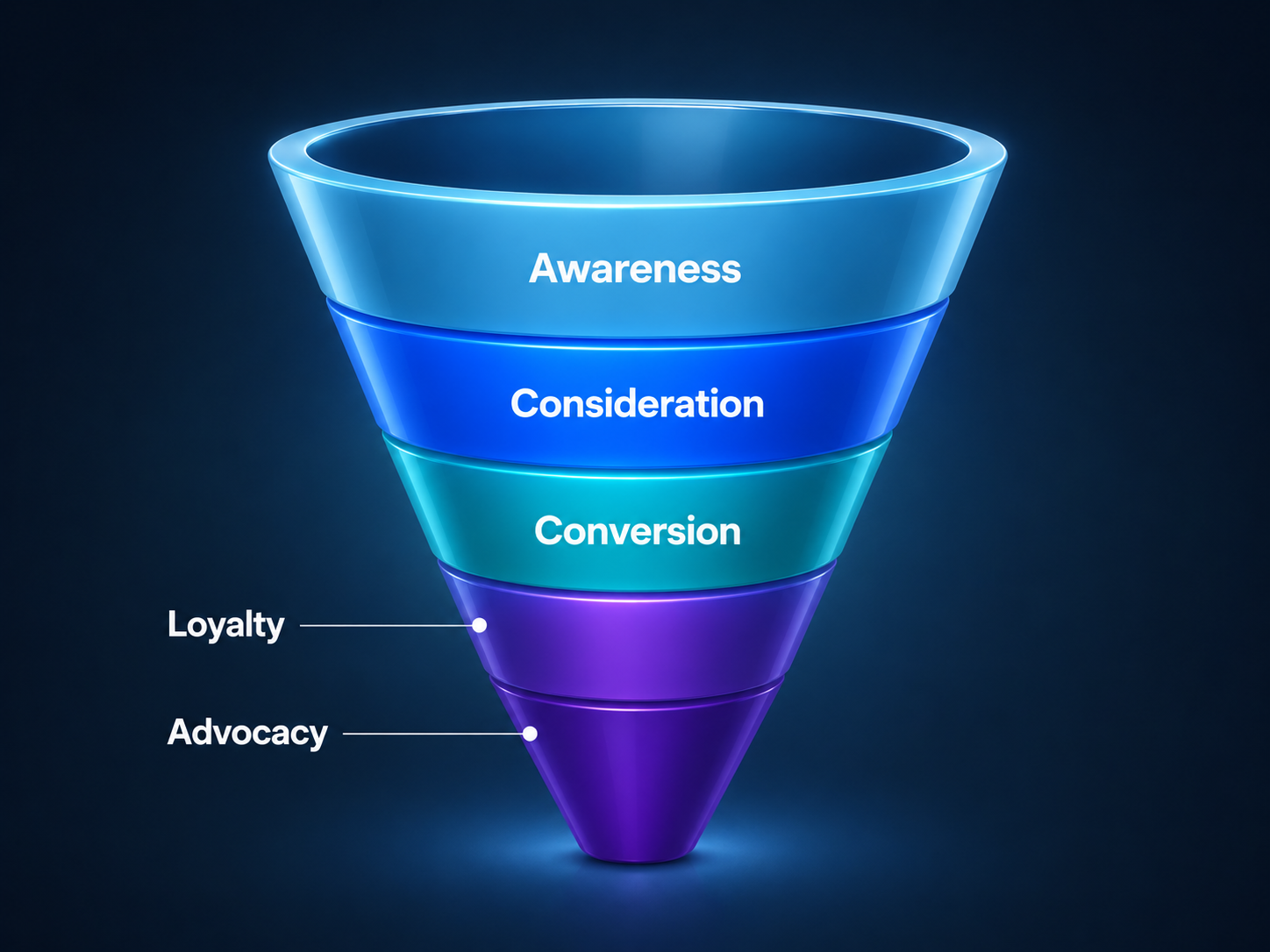
The playbook was highly predictable.
- Marketers would generate broad brand awareness at the top of the funnel.
- They would nurture prospects through a prolonged consideration phase – frequently trading an e-book or a whitepaper for an email address.
- Then mid-funnel content steered buyers toward a conversion point.
- Post-sale, organizations deployed customer success and loyalty initiatives designed to turn buyers into enthusiastic brand advocates.
Now that entire framework is useless.
ChatGPT and its contemporary engines (Perplexity, Gemini, Microsoft Copilot, and Claude) have completely hollowed out the center of this funnel.
The AI layer has entirely assumed the work of consideration, conversion, and market research.
Modern buyers no longer manually click through ten distinct organic search listings, review individual product feature tables, or complete multi-step form gates just to evaluate vendors. Instead, they prompt an AI interface:
In seconds, the machine executes the consideration and evaluation phases on behalf of the buyer. The traditional middle-of-the-funnel has been completely bypassed. 83% of the B2B buying process is now spent on independent research away from sales reps, with buyers using AI-curated content and tools like ChatGPT as primary research inputs.
Enterprise search data reveals a stark division in how modern buyers discover solutions:
- The 30% Legacy Segment: Roughly 30% of buyers still navigate the web using legacy keyword search methods, slowly clicking through blue links.
- The 40% Hybrid/Active Segment: Approximately 40% of corporate buyers now rely on generative engines to execute their initial consideration and validation steps. They only view a vendor's site after an AI recommends it.
- The 30% Autonomous Horizon: The remaining 30% are actively preparing for autonomous agent workflows, where software tools will make direct B2B buying choices based on backend data readiness.
As marketers, we must optimize for both sides of this coin. We must capture the diminishing traffic of traditional search while ensuring our brands are explicitly hardcoded into the data models used by generative engines.
If your marketing program fails to check the following four boxes, your organization will simply cease to exist in search results.
4 Steps to Make The Shift to the New AI Marketing Playbook
1. Be Known in Advance
In high-ticket B2B sales, if an enterprise buyer doesn’t recognize your brand name before a structural crisis strikes their business, you have already lost the contract.
When a system fails or an operations director faces a compliance bottleneck, they do not possess the patience to explore unfamiliar vendors.
They revert directly to the names already etched into their subconscious. This concept was historically termed Top-of-Mind Awareness (TOMA), but today it acts as your ultimate defense against AI-driven vendor displacement.
The urgency is real: 69% of B2B buyers still prefer to validate AI-generated insights with a human sales rep at critical decision points, according to Gartner’s CSO & Sales Leader Conference research.
The most effective tools for building rapid, pre-intent brand equity are targeted short-form video and contextual audio assets. These formats capture attention and build psychological familiarity long before a formal buying cycle begins.
Modern ad networks allow for highly precise, contextual distribution. You no longer need to burn enterprise budgets on broad, untargeted global campaigns. Instead, you can execute hyper-targeted, localized plays based on geography, timing, and niche industry verticals.
Real-World Example: The Trade Show Saturation Play
Imagine your organization sells specialized construction technology (ConTech) and your highest-value prospects are attending a major national convention in Orlando.
Using localized geotargeting platforms via programmatic ad networks or LinkedIn Campaign Manager, you can build a digital boundary directly around the convention center and surrounding hotels.
For the entire week of the event, every construction executive using their phone, streaming Spotify, browsing business news, or checking social feeds is exposed to your targeted video and audio shorts.
Real-World Example: Financial Hub Omnipresence
If you operate a high-value FinTech or SaaS solution, you already know your buyer personas sit within specific geographic clusters like Manhattan, Chicago, or San Francisco.
You can configure your digital media mix to deliver premium video content directly to financial professionals located within those exact zip codes. Your message hits their morning podcasts and daily digital publications.
When an operations emergency hits at those firms six months later, your brand is already the trusted incumbent in their minds.
2. Be the Answer at 3 AM
When a prospective client wakes up in a cold sweat at 3:00 AM, opens a generative engine like Perplexity or ChatGPT, and types a complex, highly specific business question, your organization must be the exact solution that the machine renders.
AI Crawler Parsing Architecture
Blended HTML/JS
Crawler bypasses content
Clean Schema
Bot extracts direct data
Achieving this requires a strict commitment to technical data architecture.
In the era of traditional SEO, many agencies dismissed structured data and technical schema as optional optimizations. In the current landscape, schema markup is the primary language through which machines comprehend your entire business.
AI engines are fundamentally resource-conscious; their web crawlers do not patiently read your beautifully styled web pages the way a human does. They crawl the backend source code looking for highly structured, predictable machine-readable metadata.
If your technical architecture is unorganized or blocked, the crawler will immediately abandon your site, meaning your brand will never appear as a cited recommendation.
Actionable Technical Blueprint
- Deploy Advanced Schema Markup: You must implement exhaustive JSON-LD schema across your entire asset library. This includes deep nesting of Organization, Product, TechArticle, and FAQPage code structures. This markup explicitly defines your market category, client case studies, and core software capabilities to the crawler.
- Audit Your Robots.txt Configurations: Many organizations inadvertently lock out modern generative bots. Ensure your robots.txt file explicitly permits access to specialized user-agents including GPTBot, ChatGPT-User, Google-Extended, PerplexityBot, and Anthropic-control.
- Monitor Infrastructure Gatekeepers: Popular edge-security platforms like Cloudflare frequently update their automated threat detection models to block high-velocity web bots. You must verify that your security rules do not accidentally categorize legitimate generative search crawlers as malicious scraper threats.
- Eliminate Client-Side JavaScript Dependencies: If your website relies on complex client-side JavaScript to render critical text, pricing data, or feature lists, AI crawlers will view a completely blank page. Ensure your core content is delivered via clean, server-side rendered HTML.
Recommended GEO Enterprise Toolkit
To audit, track, and secure your baseline visibility across generative answer engines, implement these specialized industry tools:
- ZipTie.dev: The current gold standard for enterprise GEO monitoring. It tracks your exact brand mentions, maps source citations, and provides specific content gap alerts across ChatGPT and Perplexity.
- Profound.ai: An enterprise-grade intelligence tool that tracks your brand's Share of Voice (SoV) across different LLM platforms and identifies which domains are stealing your visibility.
- Semrush AI Visibility Toolkit: Excellent for tracking how your content displays within native Google AI Overviews (AIO).
3. Be Intentionally Human
No enterprise enterprise buyer wants to do business with an anonymous corporate machine or a detached, faceless entity.
They do not want to interact with the cold efficiency of "Cyberdyne Systems". They want to align with real, accountable experts.
The internet is currently drowning in automated, machine-generated "AI slop"—low-value, generic content produced by cheap agencies pushing single-sentence prompts into language models.
This flood of digital noise has made corporate buyers intensely cynical. They recognize automated text instantly, and it drives them away.
To break through this wall of skepticism, your organization must be radically and intentionally human.
Before an enterprise executive schedules a high-ticket consultation, they will thoroughly audit your online presence. They will look at your leadership team, analyze your corporate culture, and check your pulse. Critically, 84% of B2B buyers now use review platforms as a primary research method during consideration, with AI systems increasingly sorting those results by relevance and authority.
They want to see the real individuals operating behind the enterprise software architecture.
Nothing communicates human authenticity faster or more effectively than raw, unedited, high-value video and audio content.
The Myth of High-Production Content
Many corporate marketing teams paralyze themselves believing that corporate video assets require massive production budgets, professional film crews, and months of post-production editing.
This is completely false. In fact, over-produced corporate videos often feel sterile, scripted, and dishonest.
Content Production Framework Shift
Polished Corporate Video
- Expensive 4K studio rental
- Heavily scripted, sterile marketing
- Months of editing delays
- Often ignored as corporate fluff
Radical Human Clarity
- Simple desktop camera or webcam
- Authentic, unscripted expert insight
- Same-day publication cadence
- Highly trusted by skeptical buyers
High-value buyers respond directly to raw, genuine execution. A crisp desktop video recorded straight from an internal expert’s webcam can build immense trust.
If your leadership team can spend five unscripted minutes on video breaking down a complex problem, answering a common client complaint, or explaining an operational bottleneck, publish it.
To maximize the impact of these human assets for generative search engines, you must always couple your videos with highly accurate, verbatim text transcripts. This gives your human buyers the authentic video connection they want, while providing AI crawlers with the clean, indexable text they need to cite your brand.
Essential Authentic Production Tools
- Riverside.fm / Descript: Outstanding platforms for capturing high-quality local video/audio directly from a computer browser while instantly generating clean, speaker-separated text transcripts for web indexing.
- Fathom / Fireflies.ai: Excellent for capturing internal subject matter expert insights during standard business calls, allowing you to quickly convert real-world conversations into authentic educational content.
4. Be Irrefutably Authoritative
Digital authority is no longer determined solely by backlink volume or generic domain scores. In the modern AI landscape, authority is defined by a specific, data-validated concept: your proven track record of real-world expertise.
Generative engines are designed to scan the web to identify industry leaders. They assess whether an organization has pioneered original research, published proprietary data, or introduced unique perspectives to their industry vertical.
If your company website simply replicates basic information found everywhere else online, AI engines will categorize your brand as low-value filler. You must consistently produce deep, authoritative proof of your operational capacity.
Proprietary Digital Ecosystem
- Referenced on Reddit/G2
- Cited in Industry News
- Copy-paste blog text
- No unique data points
Think of this transition the same way the business world adapted to the arrival of the corporate fax machine decades ago.
Initially, companies viewed it as a novel convenience; eventually, it simply became a mandatory infrastructure requirement for doing business.
Documenting your authoritative expertise is now an identical baseline requirement. Generative AI and conversational search now rank as the most meaningful information source for B2B purchase decisions — outranking vendor websites, product experts, and direct sales contact across nearly 18,000 global buyers. AI heavily favors brands with strong third-party validation and authoritative data footprints.
Core Strategies for Building Structural Authority
- Publish Proprietary Research and Metrics: Conduct annual benchmark surveys within your tech or SaaS niche. Package your internal platform data into unique infographics, whitepapers, and trend studies. When other websites and journalists cite your original statistics, AI engines permanently tag your brand as the primary authority for that topic.
- Establish a High-Value Podcast Architecture: Host a recurring audio series interviewing internal engineers, product heads, and enterprise clients. This creates a continuous stream of original insights that cannot be replicated by automated writing tools.
- Secure Third-Party Validation Nodes: Generative models cross-reference information across independent web sources to verify corporate credibility. You must systematically build your footprint on high-authority validation nodes, including niche media outlets, industry publications, and prominent B2B review directories like G2, Capterra, or Trustradius.
When an AI model notices your enterprise software platform consistently discussed across Reddit threads, linked in national tech news, and highly rated on verified review networks, it builds an immutable trust connection with your brand.
Your buyers are already asking AI who to call. Is your brand the answer?
Every day you delay, generative engines are recommending your competitors to enterprise buyers who never visit your website, never see your content, and never give you a chance to make your case.
Today's Media Agency helps B2B organizations build the technical infrastructure, authority signals, and content architecture that get them cited — not skipped.
GEO Strategy
Schedule a GEO Strategy Session
Frequently Asked Questions
What exactly is Generative Engine Optimization (GEO), and how does it differ from traditional SEO?
Traditional SEO targets keyword rankings on legacy search engines. GEO optimizes your digital footprint so AI platforms like ChatGPT, Perplexity, and Gemini actively cite your brand in generated responses — prioritizing schema markup, authoritative data, and conversational structure over keyword matching.
Why did ChatGPT's launch in November 2022 disrupt the traditional B2B sales funnel?
Generative AI automated the consideration and research phases buyers previously executed manually. Enterprise buyers now prompt AI to aggregate, filter, and rank vendors in seconds — bypassing mid-funnel content entirely and arriving at your site only after the AI has already recommended you.
How do AI crawlers read websites differently than human visitors?
AI crawlers ignore visual design and scan raw source code, text files, and backend data structures. Content locked inside client-side JavaScript or accordion menus is completely invisible to them — meaning your brand won't surface in conversational AI answers.
What is schema markup, and why does it matter for AI visibility?
Schema markup is structured microdata added to your site's HTML that tells AI crawlers exactly what your content means. JSON-LD schema (Organization, Product, FAQPage) eliminates guesswork for the crawler, making it significantly more likely to pull and cite your data in real-time responses.
Why does unscripted desktop video outperform polished corporate video today?
Enterprise buyers are deeply skeptical of scripted, over-produced marketing. A subject matter expert speaking directly to a webcam signals genuine expertise and human accountability — building trust faster than any studio production.
Can we use AI tools to generate our marketing content?
AI is effective for internal outlining and brainstorming. Using it to produce public-facing content generates generic copy that both buyers and AI search crawlers recognize as low-authority filler — actively hurting your GEO standing.
How do third-party platforms like Reddit or G2 affect AI search rankings?
Generative models validate credibility by cross-referencing your brand across independent sources. Consistent positive mentions on review platforms, industry publications, and community forums signal to AI engines that your brand is a trusted market leader worth recommending.
How long does a GEO strategy take to produce results?
Month 1 is foundational — technical fixes, schema, and crawl corrections with no pipeline impact. Months 6–8 produce AI-cited enterprise meetings. By month 12+, structured authority compresses Time to Convert (TTC) by 30–50%.
Editorial Transparency
Who worked on this post



Three AI tools were used in the creation of this blog post to support research, drafting, editing, and optimization. Final direction, review, and publishing were completed by the Today’s Media team.